The American higher education landscape in 2026 is no longer defined by heavy backpacks and physical libraries. Instead, it is a high-speed digital ecosystem. With the integration of AI-driven research tools, cloud-based collaboration, and sophisticated file-sharing platforms, the modern student’s success depends less on hours spent in a chair and more on the efficiency of their digital workflow.
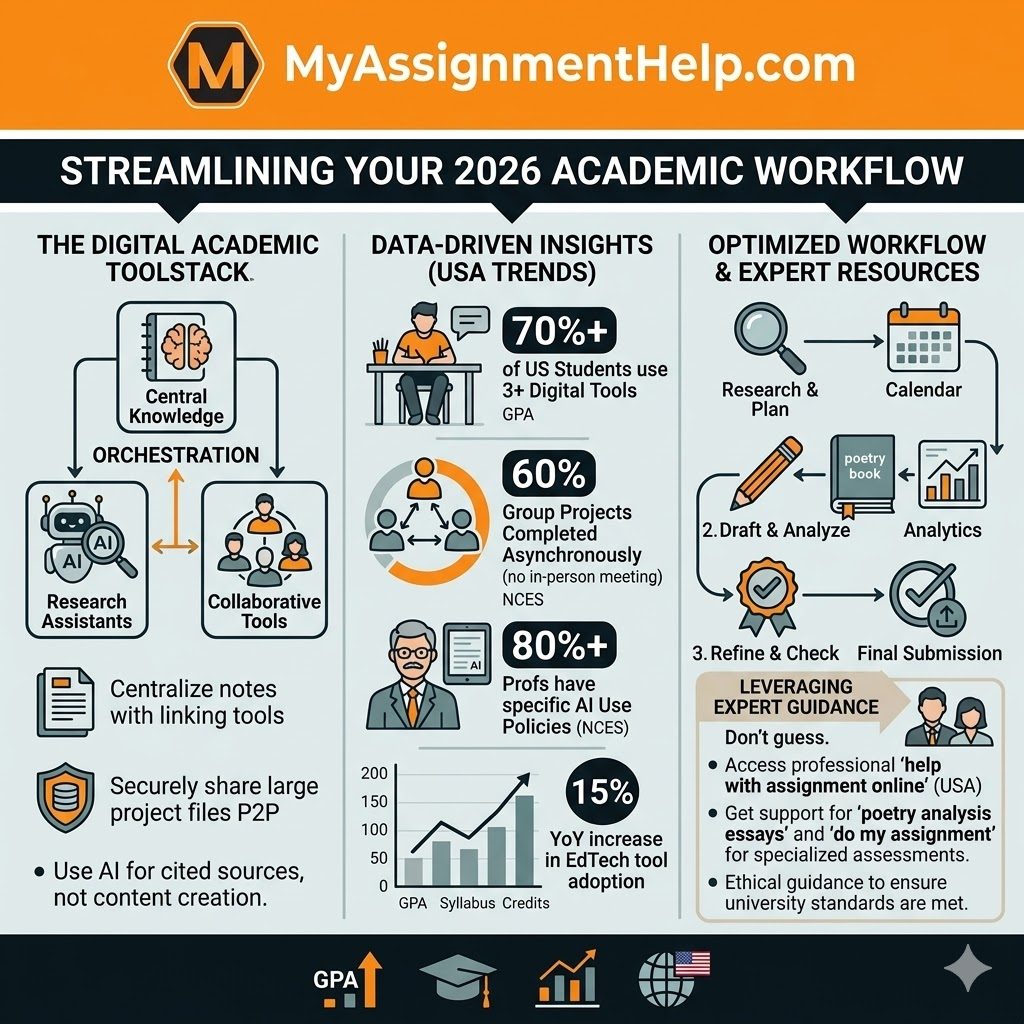
As we navigate this semester, the pressure to maintain a high GPA while balancing internships and personal growth has reached a tipping point. According to recent educational surveys, over 70% of university students in the USA now utilize at least three distinct digital platforms to manage their daily coursework. However, simply having the tools isn’t enough; the secret lies in “workflow orchestration”—the ability to make these tools work in harmony to reduce cognitive load.
For many, the transition to advanced collegiate writing involves a steep learning curve. When the complexity of a syllabus becomes overwhelming, it is common for students to seek professional help with assignment online to bridge the gap between their current skills and the rigorous standards of US universities. This strategic use of external resources allows students to focus on deep learning while ensuring their submissions meet high-level academic benchmarks.
The 2026 Digital Toolkit: Beyond the Basics
To build a streamlined workflow, you must look beyond basic word processors. The current gold standard involves a “stack” approach:
- Centralized Knowledge Management: Tools like Notion or Obsidian act as a “second brain,” allowing you to link lecture notes with research papers using bi-directional linking.
- Seamless File Transfer: Platforms like Toffeeshare have become essential for students handling large-scale media projects or collaborative data sets, providing a secure, peer-to-peer way to move files without cloud storage limits.
- Predictive Research Assistants: AI-powered search engines now provide cited, peer-reviewed sources in seconds, drastically cutting down the “search-and-sort” phase of essay writing.
Navigating Specialized Assessments
While general efficiency is vital, specialized assignments—such as literary critiques or technical labs—require a more nuanced approach. For instance, the analytical depth required for a humanities degree often surprises STEM-focused students.
If you find yourself staring at a complex piece of literature and wondering how to break down its meter, rhyme, and metaphor, you might think, “I need someone to do my assignment” to help me understand the structural requirements of a professional poetry analysis essay. Utilizing expert-curated guides and templates can transform a daunting creative task into a manageable, step-by-step process.
Data-Driven Insights: The Shift in US Education
Recent data from the National Center for Education Statistics (NCES) indicates a 15% year-over-year increase in the adoption of “EdTech” tools within domestic undergraduate programs. The 2026 academic year has seen a particular focus on:
- Asynchronous Collaboration: 60% of group projects are now completed without a single in-person meeting.
- AI Literacy: Over 80% of US professors now include specific “AI Use Policies” in their syllabi, shifting the focus from “if” AI is used to “how” it is used ethically.
- Micro-Learning: Students are increasingly using short-form video content to supplement long-form lectures, leading to a 22% improvement in retention for technical subjects.
Key Takeaways for 2026 Success
- Audit Your Stack: If a tool doesn’t save you at least 30 minutes a week, replace it.
- Prioritize Security: Use P2P sharing for sensitive research data to avoid third-party server vulnerabilities.
- Leverage Expert Guidance: Don’t wait until you are failing to seek academic support; use professional resources to learn the “how” behind high-scoring papers.
- Stay Ethical: Always use AI and external help as a foundation for your own original thought, ensuring full compliance with your university’s academic integrity code.
See also: Home Office Decor Improvements for Creativity
Frequently Asked Questions (FAQs)
Q1: How do I choose the best digital tools for my major?
Focus on interoperability and functional synergy. Select a “digital stack” where your note-taking apps, calendars, and research databases seamlessly sync across devices. Prioritize tools that offer bi-directional linking and robust API integrations to ensure your academic data remains organized, accessible, and actionable throughout the 2026 semester.
Q2: Is seeking online assignment help considered academic dishonesty?
No, provided it is used as a supplemental learning resource. Professional academic services offer model papers and structural frameworks that serve as high-level tutoring aids. When used ethically to understand complex rubrics and research methodologies, these tools empower students to produce original, high-quality work that meets university standards.
Q3: What is the most common mistake in student workflows?
The most frequent error is “digital hoarding”—collecting numerous apps, browser extensions, and PDF bookmarks without a centralized system to categorize them. This leads to information fragmentation, which increases cognitive load and ultimately slows down the drafting and submission process during busy mid-term cycles.
About the Author
James Sterling is a Senior Content Strategist at MyAssignmentHelp. With over a decade of experience in the US higher education sector, James specializes in helping students navigate the complexities of modern academic standards through data-driven writing and innovative digital strategies.
References
- National Center for Education Statistics (NCES), “Impact of Educational Technology on Student Outcomes,” 2025 Report.
- U.S. Department of Education, “Higher Education in the Digital Age,” 2026 Policy Brief.
- Journal of Interactive Online Learning, “Workflow Optimization in Virtual Classrooms,” Vol 24, Issue 2.